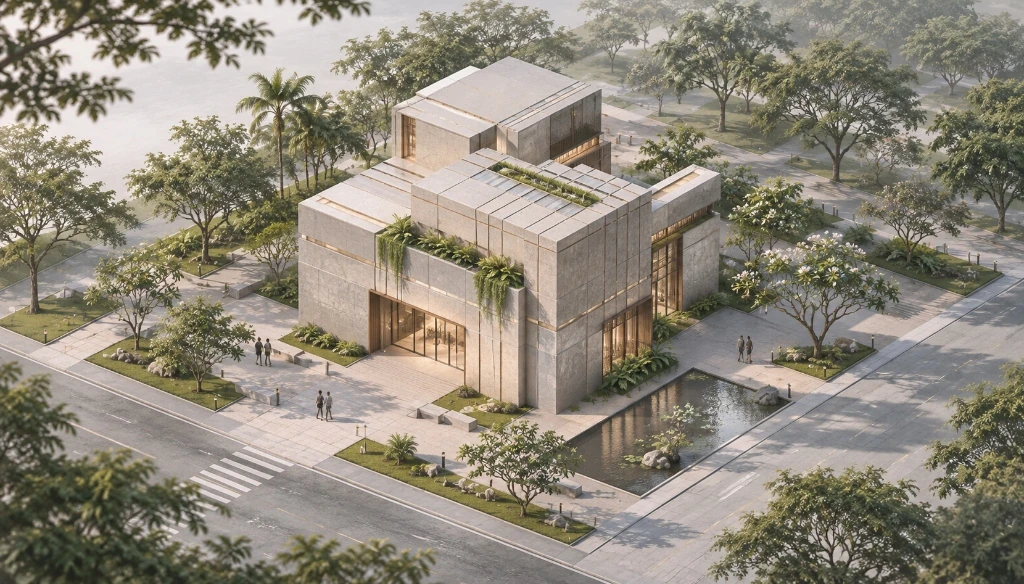
Concept & Climate-Informed Monoliths
Light-Sculpted Mass bridges generative form-finding and environmental performance analysis within a single interactive Julia application. Calibrated to the equatorial solar geometry of Bandung, Indonesia (6.9175° S, 107.6191° E), the project investigates how monumental, monolithic architecture can be carved open by courtyards, deep entrance portals, roof terraces, and narrow vertical light slots—and how those spatial voids perform under tropical daylight.
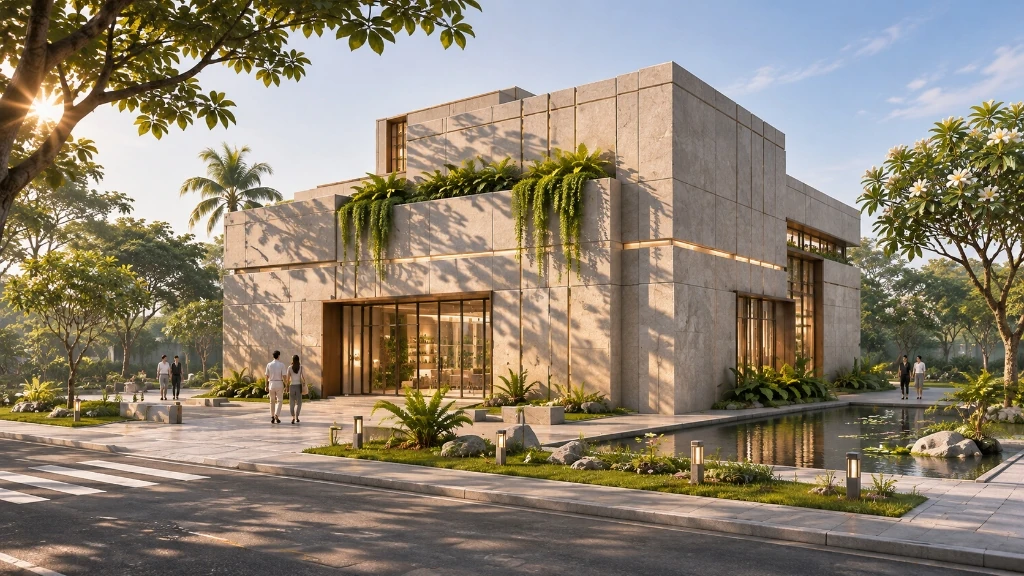
Rather than treating massing generation and solar simulation as separate stages across different software packages, this custom tool integrates Constructive Solid Geometry (CSG) directly with an analytical solar ray-casting engine and a real-time evaluation dashboard.
The Computational Logic: Boolean CSG & Solar Ray-Casting
As illustrated in the system diagram below, the software operates through two linked computational engines—first synthesizing the architectural solid-void composition, then evaluating its daily solar exposure across both building surfaces and the surrounding site:
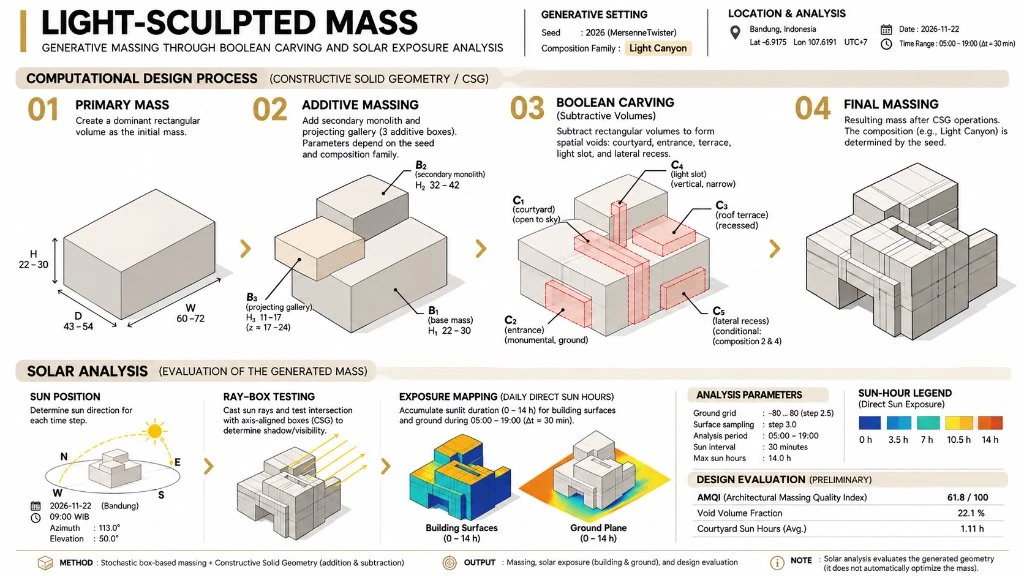
- Additive & Subtractive CSG Massing (Steps 01–04): Using a seeded generator (
Seed 2026, Light Canyon family), the algorithm first assembles three interlocking rectangular volumes: a dominant base monolith (B₁), a taller secondary tower mass (B₂), and a cantilevered upper gallery (B₃). It then subtracts up to five spatial voids—an open-to-sky central courtyard (C₁), a monumental ground entrance (C₂), a recessed roof terrace (C₃), a narrow vertical light slot (C₄), and a lateral recess (C₅)—partitioning the resulting solid into an exact boundary mesh with crisp architectural edge lines. - Equatorial Sun Position & Analytical Ray-Box Testing: For any selected date (such as
2026-11-22), the script calculates Bandung’s solar azimuth and elevation at30-minuteintervals from05:00to19:00 WIB. Every building facade is subdivided into3.0 manalytical patches and the surrounding site into a2.5 mground grid. From each sample point, solar rays are tested directly against the additive and subtractive CSG boxes to determine instantaneous shadows and cumulative daily direct sun hours (0to14 hours). - Preliminary Design Evaluation (
AMQI): It is important to note that the solar analysis evaluates the generated geometry rather than automatically optimizing it. To help the architect compare different random seeds, the dashboard computes a preliminary Architectural Massing Quality Index (AMQI = 61.8 / 100) that balances the solid-void ratio (22.1%), primary mass dominance, and average courtyard sun exposure (1.11 hours/day).
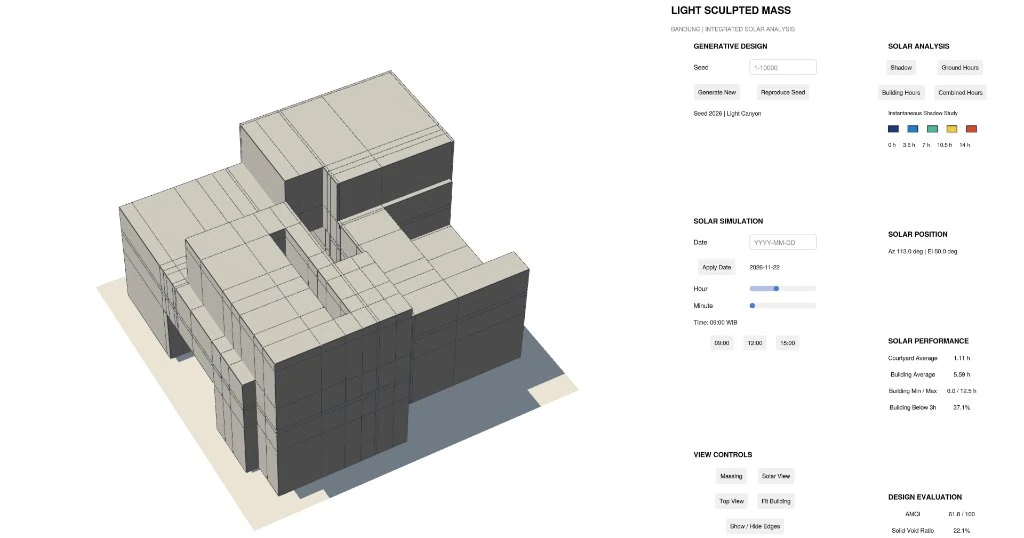
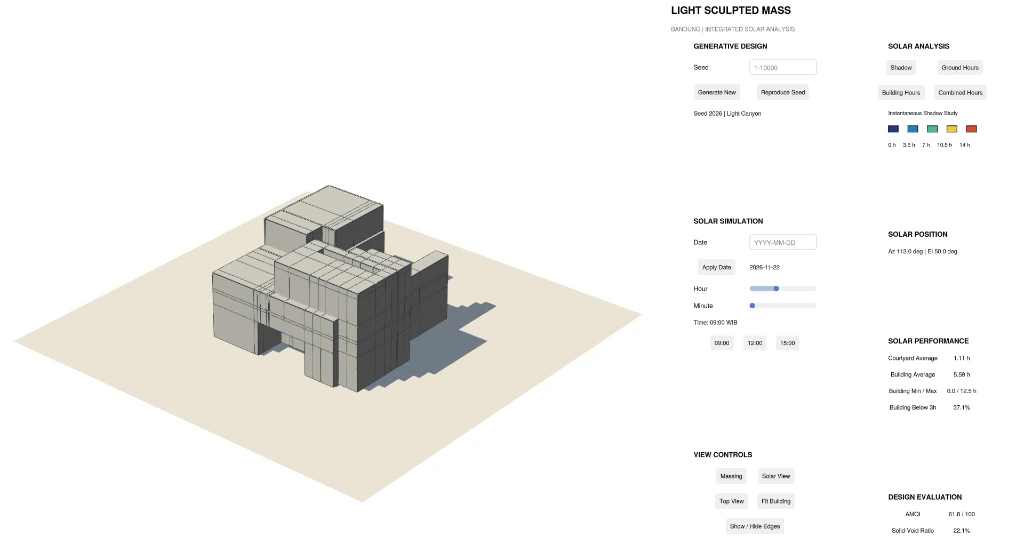
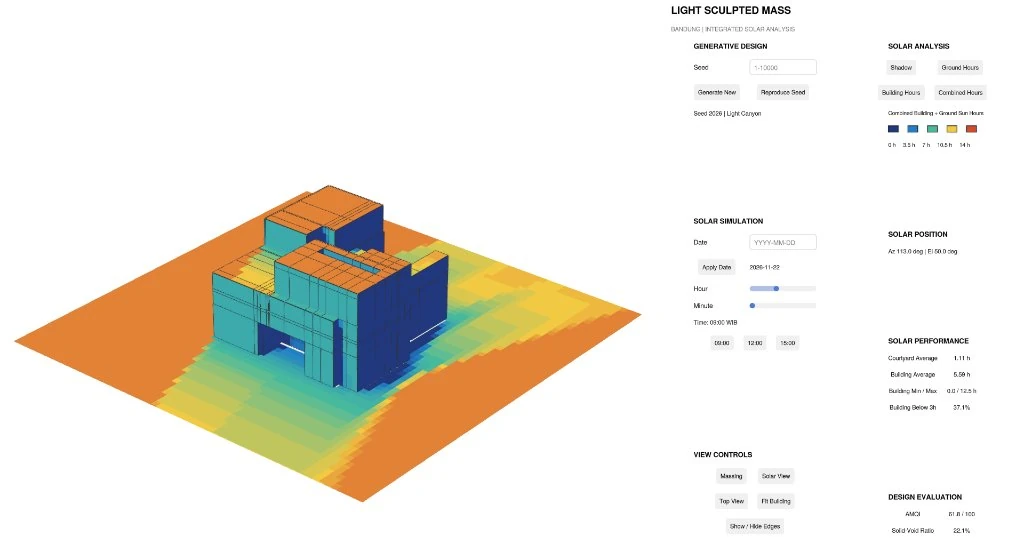
View Julia Source Code (light_sculpted_mass.jl)
using GLMakie
using GeometryBasics
using Random
using Colors
using Dates
using Statistics
# Define the geographic location
const LATITUDE = -6.9175
const LONGITUDE = 107.6191
const UTC_OFFSET = 7.0
# Define the initial design settings
const INITIAL_SEED = 2026
const INITIAL_DATE = Date(2026, 11, 22)
const INITIAL_HOUR = 9
const INITIAL_MINUTE = 0
# Define the analytical grid resolution
const GROUND_MIN = -80.0
const GROUND_MAX = 80.0
const GROUND_STEP = 2.5
const SURFACE_STEP = 3.0
# Define the daily solar analysis period
const SUN_START_HOUR = 5
const SUN_END_HOUR = 19
const SUN_INTERVAL = 30
const MAX_SUN_HOURS = 14.0
# Define the architectural material
const CONCRETE_COLOR = RGBf(0.80, 0.81, 0.79)
const CONCRETE_DIFFUSE = Vec3f(0.85, 0.85, 0.85)
const CONCRETE_SPECULAR = Vec3f(0.02, 0.02, 0.02)
const CONCRETE_SHININESS = 8f0
# Define the analytical color palette
const SOLAR_PALETTE = RGBf[
RGBf(0.13, 0.22, 0.50),
RGBf(0.13, 0.50, 0.78),
RGBf(0.28, 0.73, 0.62),
RGBf(0.95, 0.79, 0.26),
RGBf(0.83, 0.30, 0.18)
]
const NEUTRAL_GROUND = RGBf(0.92, 0.91, 0.88)
const SHADOW_COLOR = RGBf(0.44, 0.48, 0.52)
const SUNLIT_COLOR = RGBf(0.92, 0.89, 0.83)
# Define an axis-aligned architectural solid
struct BoxVolume
xmin::Float64
xmax::Float64
ymin::Float64
ymax::Float64
zmin::Float64
zmax::Float64
end
# Create a solid from its center and dimensions
function make_box(cx, cy, width, depth, zmin, zmax)
return BoxVolume(
cx - width / 2,
cx + width / 2,
cy - depth / 2,
cy + depth / 2,
zmin,
zmax
)
end
# Check whether a point lies inside a solid
function inside_box(x, y, z, box::BoxVolume)
return (
box.xmin <= x <= box.xmax &&
box.ymin <= y <= box.ymax &&
box.zmin <= z <= box.zmax
)
end
# Evaluate the final constructive solid geometry
function inside_solid(x, y, z, additions, cutters)
occupied = any(
b -> inside_box(x, y, z, b),
additions
)
if !occupied
return false
end
removed = any(
b -> inside_box(x, y, z, b),
cutters
)
return !removed
end
# Create an empty geometry container
function new_geometry()
return (
Point3f[],
TriangleFace{Int}[]
)
end
# Add a quadrilateral surface
function add_quad!(geo, a, b, c, d)
vertices, faces = geo
base = length(vertices)
append!(vertices, Point3f[a, b, c, d])
push!(
faces,
TriangleFace(base + 1, base + 2, base + 3)
)
push!(
faces,
TriangleFace(base + 1, base + 3, base + 4)
)
return nothing
end
# Convert geometry into a renderable mesh
function build_mesh(geo)
return GeometryBasics.Mesh(
geo[1],
geo[2]
)
end
# Generate a monumental architectural composition
function generate_architecture(seed)
rng = MersenneTwister(seed)
additions = BoxVolume[]
cutters = BoxVolume[]
# Select the architectural composition family
composition = rand(rng, 1:4)
names = (
"Carved Monolith",
"Shifted Monoliths",
"Terraced Monolith",
"Light Canyon"
)
# Generate the dominant primary mass
base_width = rand(rng, 60.0:1.0:72.0)
base_depth = rand(rng, 43.0:1.0:54.0)
base_height = rand(rng, 22.0:1.0:30.0)
push!(
additions,
make_box(
0.0, 0.0,
base_width,
base_depth,
0.0,
base_height
)
)
# Generate the secondary monolithic mass
side = rand(rng, (-1.0, 1.0))
secondary_x = side * rand(rng, 13.0:1.0:21.0)
secondary_y = rand(rng, 3.0:1.0:12.0)
secondary_width = rand(rng, 28.0:1.0:37.0)
secondary_depth = rand(rng, 30.0:1.0:41.0)
secondary_height = rand(rng, 32.0:1.0:42.0)
# Apply composition-specific transformations
if composition == 2
secondary_x *= 1.30
secondary_y += 5.0
elseif composition == 3
secondary_height *= 1.15
elseif composition == 4
secondary_x *= 0.75
secondary_y += 7.0
end
push!(
additions,
make_box(
secondary_x,
secondary_y,
secondary_width,
secondary_depth,
0.0,
secondary_height
)
)
# Generate a massive projecting gallery
extension_level = rand(rng, 17.0:1.0:24.0)
extension_x = -side * rand(rng, 10.0:1.0:18.0)
extension_y = rand(rng, -11.0:1.0:-4.0)
extension_width = rand(rng, 35.0:1.0:48.0)
extension_depth = rand(rng, 23.0:1.0:33.0)
extension_height = rand(rng, 11.0:1.0:17.0)
if composition == 1
extension_x *= 1.15
elseif composition == 3
extension_level += 6.0
elseif composition == 4
extension_y -= 5.0
end
push!(
additions,
make_box(
extension_x,
extension_y,
extension_width,
extension_depth,
extension_level,
extension_level + extension_height
)
)
# Generate the central open-air courtyard
courtyard_x = rand(rng, -8.0:1.0:8.0)
courtyard_y = rand(rng, 1.0:1.0:8.0)
courtyard_width = rand(rng, 15.0:1.0:23.0)
courtyard_depth = rand(rng, 18.0:1.0:27.0)
if composition == 2
courtyard_x += 7.0 * side
elseif composition == 4
courtyard_width *= 0.75
courtyard_depth *= 1.25
end
courtyard = make_box(
courtyard_x,
courtyard_y,
courtyard_width,
courtyard_depth,
-1.0,
70.0
)
push!(cutters, courtyard)
# Carve the monumental entrance
entrance_width = rand(rng, 10.0:1.0:16.0)
entrance_height = rand(rng, 12.0:1.0:19.0)
entrance_y =
courtyard_y - courtyard_depth / 2 - 11.0
push!(
cutters,
make_box(
courtyard_x,
entrance_y,
entrance_width,
28.0,
-1.0,
entrance_height
)
)
# Carve a large roof terrace
terrace_x = -side * rand(rng, 20.0:1.0:28.0)
terrace_y = rand(rng, 9.0:1.0:18.0)
terrace_width = rand(rng, 19.0:1.0:26.0)
terrace_depth = rand(rng, 18.0:1.0:27.0)
terrace_level = rand(rng, 13.0:1.0:20.0)
push!(
cutters,
make_box(
terrace_x,
terrace_y,
terrace_width,
terrace_depth,
terrace_level,
70.0
)
)
# Carve a deep vertical light slot
slot_x = secondary_x + rand(rng, -5.0:1.0:5.0)
slot_y = secondary_y + rand(rng, -4.0:1.0:4.0)
slot_width = rand(rng, 3.5:0.5:6.5)
slot_depth = rand(rng, 16.0:1.0:25.0)
slot_bottom = rand(rng, 11.0:1.0:18.0)
push!(
cutters,
make_box(
slot_x,
slot_y,
slot_width,
slot_depth,
slot_bottom,
70.0
)
)
# Generate one optional lateral recess
if composition == 2 || composition == 4
push!(
cutters,
make_box(
side * 30.0,
rand(rng, -8.0:1.0:4.0),
rand(rng, 15.0:1.0:22.0),
rand(rng, 19.0:1.0:27.0),
-1.0,
rand(rng, 12.0:1.0:19.0)
)
)
end
return (
additions=additions,
cutters=cutters,
courtyard=courtyard,
name=names[composition]
)
end
# Generate the CSG coordinate partitions
function csg_partition(design)
all_boxes = vcat(
design.additions,
design.cutters
)
xs = sort(unique(vcat(
[b.xmin for b in all_boxes],
[b.xmax for b in all_boxes]
)))
ys = sort(unique(vcat(
[b.ymin for b in all_boxes],
[b.ymax for b in all_boxes]
)))
zs = sort(unique(vcat(
[b.zmin for b in all_boxes],
[b.zmax for b in all_boxes]
)))
nx = length(xs) - 1
ny = length(ys) - 1
nz = length(zs) - 1
occupied = falses(nx, ny, nz)
volume = 0.0
# Evaluate each partition cell
for i in 1:nx, j in 1:ny, k in 1:nz
cx = (xs[i] + xs[i+1]) / 2
cy = (ys[j] + ys[j+1]) / 2
cz = (zs[k] + zs[k+1]) / 2
occupied[i, j, k] = inside_solid(
cx, cy, cz,
design.additions,
design.cutters
)
if occupied[i, j, k]
volume +=
(xs[i+1] - xs[i]) *
(ys[j+1] - ys[j]) *
(zs[k+1] - zs[k])
end
end
return (
xs=xs,
ys=ys,
zs=zs,
occupied=occupied,
volume=volume
)
end
# Subdivide a building face into analytical patches
function add_surface_patches!(
geo,
centers,
normals,
areas,
a, b, c, d,
normal
)
edge_u = sqrt(sum(
(Float64(b[i]) - Float64(a[i]))^2
for i in 1:3
))
edge_v = sqrt(sum(
(Float64(d[i]) - Float64(a[i]))^2
for i in 1:3
))
nu = max(1, ceil(Int, edge_u / SURFACE_STEP))
nv = max(1, ceil(Int, edge_v / SURFACE_STEP))
function point_at(u, v)
return Point3f(
a[1] + u * (b[1] - a[1]) +
v * (d[1] - a[1]),
a[2] + u * (b[2] - a[2]) +
v * (d[2] - a[2]),
a[3] + u * (b[3] - a[3]) +
v * (d[3] - a[3])
)
end
patch_area = edge_u * edge_v / (nu * nv)
for i in 1:nu, j in 1:nv
u1 = (i - 1) / nu
u2 = i / nu
v1 = (j - 1) / nv
v2 = j / nv
p1 = point_at(u1, v1)
p2 = point_at(u2, v1)
p3 = point_at(u2, v2)
p4 = point_at(u1, v2)
add_quad!(geo, p1, p2, p3, p4)
center = point_at(
(u1 + u2) / 2,
(v1 + v2) / 2
)
push!(
centers,
(
Float64(center[1]),
Float64(center[2]),
Float64(center[3])
)
)
push!(normals, normal)
push!(areas, patch_area)
end
return nothing
end
# Generate the external CSG building surfaces
function generate_building_surfaces(design)
partition = csg_partition(design)
xs = partition.xs
ys = partition.ys
zs = partition.zs
occupied = partition.occupied
nx, ny, nz = size(occupied)
geo = new_geometry()
centers = NTuple{3,Float64}[]
normals = NTuple{3,Float64}[]
areas = Float64[]
p(x, y, z) = Point3f(x, y, z)
# Construct outward-facing boundary surfaces
for i in 1:nx, j in 1:ny, k in 1:nz
if !occupied[i, j, k]
continue
end
x1, x2 = xs[i], xs[i+1]
y1, y2 = ys[j], ys[j+1]
z1, z2 = zs[k], zs[k+1]
# Negative X face
if i == 1 || !occupied[i-1, j, k]
add_surface_patches!(
geo, centers, normals, areas,
p(x1, y1, z1),
p(x1, y1, z2),
p(x1, y2, z2),
p(x1, y2, z1),
(-1.0, 0.0, 0.0)
)
end
# Positive X face
if i == nx || !occupied[i+1, j, k]
add_surface_patches!(
geo, centers, normals, areas,
p(x2, y1, z1),
p(x2, y2, z1),
p(x2, y2, z2),
p(x2, y1, z2),
(1.0, 0.0, 0.0)
)
end
# Negative Y face
if j == 1 || !occupied[i, j-1, k]
add_surface_patches!(
geo, centers, normals, areas,
p(x1, y1, z1),
p(x2, y1, z1),
p(x2, y1, z2),
p(x1, y1, z2),
(0.0, -1.0, 0.0)
)
end
# Positive Y face
if j == ny || !occupied[i, j+1, k]
add_surface_patches!(
geo, centers, normals, areas,
p(x2, y2, z1),
p(x1, y2, z1),
p(x1, y2, z2),
p(x2, y2, z2),
(0.0, 1.0, 0.0)
)
end
# Bottom face
if k == 1 || !occupied[i, j, k-1]
add_surface_patches!(
geo, centers, normals, areas,
p(x1, y2, z1),
p(x2, y2, z1),
p(x2, y1, z1),
p(x1, y1, z1),
(0.0, 0.0, -1.0)
)
end
# Top face
if k == nz || !occupied[i, j, k+1]
add_surface_patches!(
geo, centers, normals, areas,
p(x1, y1, z2),
p(x2, y1, z2),
p(x2, y2, z2),
p(x1, y2, z2),
(0.0, 0.0, 1.0)
)
end
end
return (
mesh=build_mesh(geo),
centers=centers,
normals=normals,
areas=areas,
volume=partition.volume
)
end
# Extract architectural edges from the CSG boundary
function generate_architectural_edges(design)
partition = csg_partition(design)
xs = partition.xs
ys = partition.ys
zs = partition.zs
occupied = partition.occupied
nx, ny, nz = size(occupied)
# Store unique geometric edges
edge_set = Set{
Tuple{NTuple{3,Float64},NTuple{3,Float64}}
}()
# Register each edge only once
function add_edge!(a, b)
p1 = (
Float64(a[1]),
Float64(a[2]),
Float64(a[3])
)
p2 = (
Float64(b[1]),
Float64(b[2]),
Float64(b[3])
)
if p1 == p2
return nothing
end
edge = isless(p1, p2) ?
(p1, p2) : (p2, p1)
push!(edge_set, edge)
return nothing
end
# Register the four boundary edges of a face
function add_face_edges!(a, b, c, d)
add_edge!(a, b)
add_edge!(b, c)
add_edge!(c, d)
add_edge!(d, a)
return nothing
end
# Process every occupied CSG cell
for i in 1:nx, j in 1:ny, k in 1:nz
if !occupied[i, j, k]
continue
end
x1, x2 = xs[i], xs[i+1]
y1, y2 = ys[j], ys[j+1]
z1, z2 = zs[k], zs[k+1]
p(x, y, z) = (x, y, z)
# Negative X boundary
if i == 1 || !occupied[i-1, j, k]
add_face_edges!(
p(x1, y1, z1), p(x1, y1, z2),
p(x1, y2, z2), p(x1, y2, z1)
)
end
# Positive X boundary
if i == nx || !occupied[i+1, j, k]
add_face_edges!(
p(x2, y1, z1), p(x2, y2, z1),
p(x2, y2, z2), p(x2, y1, z2)
)
end
# Negative Y boundary
if j == 1 || !occupied[i, j-1, k]
add_face_edges!(
p(x1, y1, z1), p(x2, y1, z1),
p(x2, y1, z2), p(x1, y1, z2)
)
end
# Positive Y boundary
if j == ny || !occupied[i, j+1, k]
add_face_edges!(
p(x2, y2, z1), p(x1, y2, z1),
p(x1, y2, z2), p(x2, y2, z2)
)
end
# Bottom boundary
if k == 1 || !occupied[i, j, k-1]
add_face_edges!(
p(x1, y2, z1), p(x2, y2, z1),
p(x2, y1, z1), p(x1, y1, z1)
)
end
# Top boundary
if k == nz || !occupied[i, j, k+1]
add_face_edges!(
p(x1, y1, z2), p(x2, y1, z2),
p(x2, y2, z2), p(x1, y2, z2)
)
end
end
# Convert unique edges into line segments
segments = Point3f[]
for (a, b) in edge_set
push!(segments, Point3f(a...))
push!(segments, Point3f(b...))
end
return segments
end
# Calculate approximate solar position
function solar_position(datetime)
day_number = dayofyear(datetime)
year_length =
isleapyear(year(datetime)) ? 366 : 365
local_hour =
Dates.hour(datetime) +
Dates.minute(datetime) / 60
gamma = 2π / year_length * (
day_number - 1 +
(local_hour - 12) / 24
)
equation_of_time = 229.18 * (
0.000075 +
0.001868 * cos(gamma) -
0.032077 * sin(gamma) -
0.014615 * cos(2 * gamma) -
0.040849 * sin(2 * gamma)
)
declination =
0.006918 -
0.399912 * cos(gamma) +
0.070257 * sin(gamma) -
0.006758 * cos(2 * gamma) +
0.000907 * sin(2 * gamma) -
0.002697 * cos(3 * gamma) +
0.00148 * sin(3 * gamma)
solar_minutes =
local_hour * 60 +
equation_of_time +
4 * LONGITUDE -
60 * UTC_OFFSET
hour_angle = deg2rad(
solar_minutes / 4 - 180
)
lat = deg2rad(LATITUDE)
sin_elevation =
sin(lat) * sin(declination) +
cos(lat) * cos(declination) *
cos(hour_angle)
elevation = rad2deg(
asin(clamp(sin_elevation, -1.0, 1.0))
)
azimuth = mod(
rad2deg(
atan(
sin(hour_angle),
cos(hour_angle) * sin(lat) -
tan(declination) * cos(lat)
)
) + 180,
360
)
return azimuth, elevation
end
# Convert solar angles to ENU coordinates
# X = East, Y = North, Z = Up
function sun_vector(azimuth, elevation)
az = deg2rad(azimuth)
el = deg2rad(elevation)
return (
cos(el) * sin(az),
cos(el) * cos(az),
sin(el)
)
end
# Calculate ray intersection with a box
function ray_box_interval(origin, direction, box)
lower = (box.xmin, box.ymin, box.zmin)
upper = (box.xmax, box.ymax, box.zmax)
tmin = 0.0
tmax = Inf
for axis in 1:3
o = origin[axis]
d = direction[axis]
if abs(d) < 1.0e-10
if o < lower[axis] || o > upper[axis]
return nothing
end
else
t1 = (lower[axis] - o) / d
t2 = (upper[axis] - o) / d
tmin = max(tmin, min(t1, t2))
tmax = min(tmax, max(t1, t2))
if tmax <= tmin
return nothing
end
end
end
return (tmin, tmax)
end
# Test whether a solar ray is blocked by the CSG solid
function ray_blocked(origin, direction, design)
events = Float64[0.0]
has_addition = false
# Collect additive volume intersections
for box in design.additions
hit = ray_box_interval(
origin,
direction,
box
)
if hit !== nothing
has_addition = true
push!(
events,
hit[1],
hit[2]
)
end
end
if !has_addition
return false
end
# Include subtraction boundaries
for box in design.cutters
hit = ray_box_interval(
origin,
direction,
box
)
if hit !== nothing
push!(
events,
hit[1],
hit[2]
)
end
end
sort!(events)
unique!(events)
# Test every interval between successive events
for i in 1:(length(events)-1)
t1 = events[i]
t2 = events[i+1]
if t2 - t1 <= 1.0e-7
continue
end
t = (t1 + t2) / 2
x = origin[1] + direction[1] * t
y = origin[2] + direction[2] * t
z = origin[3] + direction[3] * t
if inside_solid(
x, y, z,
design.additions,
design.cutters
)
return true
end
end
return false
end
# Check direct sunlight on a ground point
function ground_receives_sun(x, y, direction, design)
if direction[3] <= 0.0
return false
end
origin = (x, y, 0.08)
return !ray_blocked(
origin,
direction,
design
)
end
# Check direct sunlight on a building surface
function surface_receives_sun(
center,
normal,
direction,
design
)
if direction[3] <= 0.0
return false
end
incidence =
normal[1] * direction[1] +
normal[2] * direction[2] +
normal[3] * direction[3]
if incidence <= 1.0e-6
return false
end
origin = (
center[1] + normal[1] * 0.08,
center[2] + normal[2] * 0.08,
center[3] + normal[3] * 0.08
)
return !ray_blocked(
origin,
direction,
design
)
end
# Generate the analytical ground mesh
function generate_ground_grid()
geo = new_geometry()
centers = NTuple{2,Float64}[]
step = GROUND_STEP
for x in GROUND_MIN:step:(GROUND_MAX-step)
for y in GROUND_MIN:step:(GROUND_MAX-step)
push!(
centers,
(x + step / 2, y + step / 2)
)
add_quad!(
geo,
Point3f(x, y, -0.15),
Point3f(x + step, y, -0.15),
Point3f(x + step, y + step, -0.15),
Point3f(x, y + step, -0.15)
)
end
end
return (
mesh=build_mesh(geo),
centers=centers
)
end
# Generate sun directions at fixed time intervals
function daily_sun_vectors(date)
vectors = NTuple{3,Float64}[]
start_minutes = SUN_START_HOUR * 60
end_minutes = SUN_END_HOUR * 60
time_range = range(
start_minutes,
stop=end_minutes - SUN_INTERVAL,
step=SUN_INTERVAL
)
for minutes in time_range
midpoint = minutes + SUN_INTERVAL ÷ 2
datetime = DateTime(date) + Minute(midpoint)
azimuth, elevation = solar_position(datetime)
if elevation > 0.0
push!(
vectors,
sun_vector(azimuth, elevation)
)
end
end
return vectors
end
# Calculate direct sun hours on ground samples
function calculate_ground_hours(design, date, centers)
values = zeros(Float64, length(centers))
directions = daily_sun_vectors(date)
dt = SUN_INTERVAL / 60
for (i, center) in enumerate(centers)
x, y = center
# Mark building footprints as invalid analysis cells
if inside_solid(
x, y, 0.05,
design.additions,
design.cutters
)
values[i] = NaN
continue
end
for direction in directions
if ground_receives_sun(
x, y,
direction,
design
)
values[i] += dt
end
end
end
return values
end
# Calculate direct sun hours on building surfaces
function calculate_surface_hours(design, date, surfaces)
values = zeros(
Float64,
length(surfaces.centers)
)
directions = daily_sun_vectors(date)
dt = SUN_INTERVAL / 60
for i in eachindex(surfaces.centers)
center = surfaces.centers[i]
normal = surfaces.normals[i]
# Exclude downward-facing building surfaces
if normal[3] < -0.5
values[i] = NaN
continue
end
for direction in directions
if surface_receives_sun(
center,
normal,
direction,
design
)
values[i] += dt
end
end
end
return values
end
# Convert sun hours into a heatmap color
function heatmap_color(hours)
if !isfinite(hours)
return NEUTRAL_GROUND
end
t = Float32(clamp(
hours / MAX_SUN_HOURS,
0.0,
1.0
))
position = t * 4f0
index = clamp(
floor(Int, position) + 1,
1, 4
)
fraction = clamp(
position - Float32(index - 1),
0f0,
1f0
)
a = SOLAR_PALETTE[index]
b = SOLAR_PALETTE[index+1]
return RGBf(
(1f0 - fraction) * a.r + fraction * b.r,
(1f0 - fraction) * a.g + fraction * b.g,
(1f0 - fraction) * a.b + fraction * b.b
)
end
# Expand each analytical color to four vertices
function expand_colors(cell_colors)
result = RGBf[]
sizehint!(
result,
4 * length(cell_colors)
)
for color in cell_colors
append!(
result,
(color, color, color, color)
)
end
return result
end
# Calculate instantaneous ground shadow colors
function shadow_ground_colors(
design,
centers,
azimuth,
elevation
)
direction = sun_vector(azimuth, elevation)
colors = RGBf[]
for (x, y) in centers
exposed = ground_receives_sun(
x, y,
direction,
design
)
push!(
colors,
exposed ? SUNLIT_COLOR : SHADOW_COLOR
)
end
return colors
end
# Calculate courtyard daily solar statistics
function courtyard_statistics(design, date)
courtyard = design.courtyard
directions = daily_sun_vectors(date)
values = Float64[]
dt = SUN_INTERVAL / 60
for x in range(
courtyard.xmin + 1,
courtyard.xmax - 1,
length=9
)
for y in range(
courtyard.ymin + 1,
courtyard.ymax - 1,
length=9
)
if inside_solid(
x, y, 0.05,
design.additions,
design.cutters
)
continue
end
hours = 0.0
for direction in directions
if ground_receives_sun(
x, y,
direction,
design
)
hours += dt
end
end
push!(values, hours)
end
end
if isempty(values)
return (
average=0.0,
minimum=0.0,
maximum=0.0,
shaded_percent=0.0
)
end
return (
average=mean(values),
minimum=minimum(values),
maximum=maximum(values),
shaded_percent=
100 * count(h -> h < 3.0, values) /
length(values)
)
end
# Calculate area-weighted building solar statistics
function surface_statistics(surfaces, hours)
valid = [
i for i in eachindex(hours)
if isfinite(hours[i]) &&
surfaces.normals[i][3] > -0.5
]
if isempty(valid)
return (
average=0.0,
minimum=0.0,
maximum=0.0,
shaded_percent=0.0
)
end
total_area = sum(
surfaces.areas[i]
for i in valid
)
average = sum(
hours[i] * surfaces.areas[i]
for i in valid
) / max(total_area, 1.0e-9)
shaded_area = sum(
surfaces.areas[i]
for i in valid
if hours[i] < 3.0
)
return (
average=average,
minimum=minimum(hours[i] for i in valid),
maximum=maximum(hours[i] for i in valid),
shaded_percent=
100 * shaded_area / total_area
)
end
# Calculate the preliminary massing quality index
function evaluate_design(design, surfaces, courtyard_stats)
original_design = (
additions=design.additions,
cutters=BoxVolume[]
)
original_volume =
csg_partition(original_design).volume
void_ratio = clamp(
1 - surfaces.volume / max(original_volume, 1.0),
0.0,
1.0
)
volumes = [
(b.xmax - b.xmin) *
(b.ymax - b.ymin) *
(b.zmax - b.zmin)
for b in design.additions
]
dominance = maximum(volumes) / sum(volumes)
void_score = 100 * clamp(
1 - abs(void_ratio - 0.25) / 0.25,
0.0,
1.0
)
dominance_score = 100 * clamp(
1 - abs(dominance - 0.50) / 0.50,
0.0,
1.0
)
sun_score = 100 * clamp(
1 - abs(courtyard_stats.average - 5.0) / 5.0,
0.0,
1.0
)
score =
0.35 * void_score +
0.30 * dominance_score +
0.35 * sun_score
return (
score=score,
void_ratio=void_ratio,
dominance=dominance,
volume=surfaces.volume
)
end
# Create the geographic compass
function create_compass!(ax)
ox, oy = -56.0, -55.0
oz = 0.20f0
radius = 5.0
lines!(
ax,
Point3f[
Point3f(ox - radius, oy, oz),
Point3f(ox + radius, oy, oz)
],
color=:gray35,
linewidth=2
)
lines!(
ax,
Point3f[
Point3f(ox, oy - radius, oz),
Point3f(ox, oy + radius, oz)
],
color=:gray35,
linewidth=2
)
lines!(
ax,
Point3f[
Point3f(ox, oy, oz),
Point3f(ox, oy + radius, oz)
],
color=:darkred,
linewidth=4
)
for (letter, dx, dy) in (
("N", 0.0, 7.0),
("E", 7.0, 0.0),
("S", 0.0, -7.0),
("W", -7.0, 0.0)
)
text!(
ax,
letter,
position=Point3f(
ox + dx,
oy + dy,
oz + 0.1
),
color=:black,
fontsize=16,
align=(:center, :center)
)
end
return nothing
end
# Initialize the application figure
fig = Figure(
size=(1900, 960),
backgroundcolor=:white,
figure_padding=8,
fontsize=12
)
# Allocate width between viewport and dashboard
colsize!(fig.layout, 1, Relative(0.65))
colgap!(fig.layout, 10)
# Create the 3D architectural viewport
ax = Axis3(
fig[1, 1],
aspect=:data,
viewmode=:fitzoom,
azimuth=0.34π,
elevation=0.25π,
perspectiveness=0.18,
protrusions=0,
backgroundcolor=RGBf(0.97, 0.97, 0.97)
)
hidedecorations!(ax)
hidespines!(ax)
# Initialize the lighting environment
set_ambient_light!(
ax,
RGBf(0.35, 0.35, 0.36)
)
set_directional_light!(
ax;
color=RGBf(1.0, 0.96, 0.89),
direction=Vec3f(-0.5, -0.5, -0.7),
camera_relative=false
)
# Generate the initial design
initial_design = generate_architecture(INITIAL_SEED)
initial_surfaces = generate_building_surfaces(
initial_design
)
ground_grid = generate_ground_grid()
# Calculate initial daily solar exposure
initial_ground_hours = calculate_ground_hours(
initial_design,
INITIAL_DATE,
ground_grid.centers
)
initial_surface_hours = calculate_surface_hours(
initial_design,
INITIAL_DATE,
initial_surfaces
)
initial_courtyard_stats = courtyard_statistics(
initial_design,
INITIAL_DATE
)
initial_surface_stats = surface_statistics(
initial_surfaces,
initial_surface_hours
)
initial_scores = evaluate_design(
initial_design,
initial_surfaces,
initial_courtyard_stats
)
initial_datetime =
DateTime(INITIAL_DATE) +
Hour(INITIAL_HOUR) +
Minute(INITIAL_MINUTE)
initial_azimuth, initial_elevation =
solar_position(initial_datetime)
# Store current architectural state
current_design = Ref(initial_design)
current_surfaces = Ref(initial_surfaces)
current_date = Ref(INITIAL_DATE)
current_ground_hours = Ref(initial_ground_hours)
current_surface_hours = Ref(initial_surface_hours)
current_seed = Observable(INITIAL_SEED)
current_name = Observable(initial_design.name)
current_courtyard_stats =
Observable(initial_courtyard_stats)
current_surface_stats =
Observable(initial_surface_stats)
current_scores = Observable(initial_scores)
solar_azimuth_obs = Observable(initial_azimuth)
solar_elevation_obs = Observable(initial_elevation)
# Define the available analysis modes
analysis_mode = Ref(:combined)
camera_mode = Ref(:massing)
analysis_label = Observable(
"Combined Building + Ground Sun Hours"
)
# Initialize geometry observables
building_mesh_obs = Observable(initial_surfaces.mesh)
# Initialize ground and building heatmap colors
initial_ground_colors = [
heatmap_color(h)
for h in initial_ground_hours
]
initial_surface_colors = [
heatmap_color(h)
for h in initial_surface_hours
]
ground_colors_obs = Observable(
expand_colors(initial_ground_colors)
)
surface_colors_obs = Observable(
expand_colors(initial_surface_colors)
)
# Control the two architectural rendering modes
concrete_visible = Observable(false)
surface_visible = Observable(true)
# Render the ground analysis
mesh!(
ax,
ground_grid.mesh,
color=ground_colors_obs,
shading=false
)
# Render the concrete building
mesh!(
ax,
building_mesh_obs,
color=CONCRETE_COLOR,
shading=true,
diffuse=CONCRETE_DIFFUSE,
specular=CONCRETE_SPECULAR,
shininess=CONCRETE_SHININESS,
visible=concrete_visible
)
# Render the building surface heatmap
mesh!(
ax,
building_mesh_obs,
color=surface_colors_obs,
shading=false,
visible=surface_visible
)
# Generate architectural edge geometry
initial_edges = generate_architectural_edges(
initial_design
)
# Store edge geometry for interactive updates
edges_obs = Observable(initial_edges)
# Control architectural edge visibility
edges_visible = Observable(true)
# Display architectural boundary lines
linesegments!(
ax,
edges_obs,
color=RGBf(0.18, 0.20, 0.22),
linewidth=1.5,
visible=edges_visible
)
# Display geographic orientation
create_compass!(ax)
# Define architectural framing modes
function fit_building!(design; mode=:massing)
boxes = design.additions
xmin = minimum(b.xmin for b in boxes)
xmax = maximum(b.xmax for b in boxes)
ymin = minimum(b.ymin for b in boxes)
ymax = maximum(b.ymax for b in boxes)
zmax = maximum(b.zmax for b in boxes)
if mode == :massing
margin = 5.0
limits!(
ax,
xmin - margin, xmax + margin,
ymin - margin, ymax + margin,
-1.0, zmax + 3.0
)
elseif mode == :solar
limits!(
ax,
-78.0, 78.0,
-78.0, 78.0,
-2.0,
max(zmax + 5.0, 48.0)
)
else
limits!(
ax,
-59.0, 59.0,
-59.0, 59.0,
-2.0,
zmax + 5.0
)
end
return nothing
end
# Create a compact, always-visible dashboard on the right
# Two columns reduce height without hiding any controls
panel = GridLayout()
fig[1, 2] = panel
rowgap!(panel, 7)
colgap!(panel, 12)
# Display the application identity above both columns
Label(
panel[1, 1:2],
"LIGHT SCULPTED MASS",
fontsize=19,
font=:bold,
halign=:left
)
Label(
panel[2, 1:2],
"BANDUNG | INTEGRATED SOLAR ANALYSIS",
fontsize=11,
color=:gray45,
halign=:left
)
# Split controls into two independent compact columns
left_panel = GridLayout()
right_panel = GridLayout()
panel[3, 1] = left_panel
panel[3, 2] = right_panel
rowgap!(left_panel, 6)
rowgap!(right_panel, 6)
colgap!(left_panel, 7)
colgap!(right_panel, 7)
# Use equal dashboard column widths
colsize!(panel, 1, Relative(0.49))
colsize!(panel, 2, Relative(0.49))
# Generative design controls
Label(left_panel[1, 1:2], "GENERATIVE DESIGN",
fontsize=13, font=:bold, halign=:left)
Label(left_panel[2, 1], "Seed", halign=:left)
seed_input = Textbox(
left_panel[2, 2],
placeholder="1-10000",
validator=s -> begin
n = tryparse(Int, strip(s))
n !== nothing && 1 <= n <= 10000
end,
width=125,
height=28
)
generate_button = Button(left_panel[3, 1],
label="Generate New", height=30, fontsize=11)
reproduce_button = Button(left_panel[3, 2],
label="Reproduce Seed", height=30, fontsize=11)
Label(left_panel[4, 1:2],
lift((s, n) -> "Seed $s | $n", current_seed, current_name),
fontsize=11, halign=:left)
# Bandung date and time controls
Label(left_panel[6, 1:2], "SOLAR SIMULATION",
fontsize=13, font=:bold, halign=:left)
Label(left_panel[7, 1], "Date", halign=:left)
date_input = Textbox(
left_panel[7, 2],
placeholder="YYYY-MM-DD",
validator=s -> begin
try
Date(strip(s), dateformat"yyyy-mm-dd")
true
catch
false
end
end,
width=125,
height=28
)
apply_date_button = Button(left_panel[8, 1],
label="Apply Date", height=30, fontsize=11)
date_label = Observable(string(INITIAL_DATE))
Label(left_panel[8, 2], date_label,
fontsize=11, halign=:left)
Label(left_panel[9, 1], "Hour", halign=:left)
hour_slider = Slider(left_panel[9, 2],
range=0:23, startvalue=INITIAL_HOUR)
Label(left_panel[10, 1], "Minute", halign=:left)
minute_slider = Slider(left_panel[10, 2],
range=0:5:55, startvalue=INITIAL_MINUTE)
Label(left_panel[11, 1:2],
lift(
(h, m) -> "Time: " * lpad(string(h), 2, '0') * ":" *
lpad(string(m), 2, '0') * " WIB",
hour_slider.value, minute_slider.value
),
fontsize=11, halign=:left
)
# Place all time presets on one compact row
time_controls = GridLayout()
left_panel[12, 1:2] = time_controls
colgap!(time_controls, 4)
morning_button = Button(time_controls[1, 1],
label="09:00", height=28, fontsize=11)
noon_button = Button(time_controls[1, 2],
label="12:00", height=28, fontsize=11)
afternoon_button = Button(time_controls[1, 3],
label="15:00", height=28, fontsize=11)
# Camera controls remain visible without scrolling
Label(left_panel[14, 1:2], "VIEW CONTROLS",
fontsize=13, font=:bold, halign=:left)
camera_controls = GridLayout()
left_panel[15, 1:2] = camera_controls
rowgap!(camera_controls, 4)
colgap!(camera_controls, 5)
massing_button = Button(camera_controls[1, 1],
label="Massing", height=29, fontsize=11)
solar_button = Button(camera_controls[1, 2],
label="Solar View", height=29, fontsize=11)
top_button = Button(camera_controls[2, 1],
label="Top View", height=29, fontsize=11)
fit_button = Button(camera_controls[2, 2],
label="Fit Building", height=29, fontsize=11)
# Architectural edge visibility
edge_button = Button(left_panel[16, 1:2],
label="Show / Hide Edges", height=29, fontsize=11)
on(edge_button.clicks) do _
edges_visible[] = !edges_visible[]
end
# Right column: analysis mode controls
Label(right_panel[1, 1:2], "SOLAR ANALYSIS",
fontsize=13, font=:bold, halign=:left)
analysis_controls = GridLayout()
right_panel[2, 1:2] = analysis_controls
rowgap!(analysis_controls, 4)
colgap!(analysis_controls, 5)
shadow_button = Button(analysis_controls[1, 1],
label="Shadow", height=29, fontsize=11)
ground_button = Button(analysis_controls[1, 2],
label="Ground Hours", height=29, fontsize=11)
building_button = Button(analysis_controls[2, 1],
label="Building Hours", height=29, fontsize=11)
combined_button = Button(analysis_controls[2, 2],
label="Combined Hours", height=29, fontsize=11)
Label(right_panel[3, 1:2], analysis_label,
fontsize=10, halign=:left)
# Five-color direct sun hours legend
legend_grid = GridLayout()
right_panel[4, 1:2] = legend_grid
colgap!(legend_grid, 2)
for i in 1:5
Box(legend_grid[1, i], color=SOLAR_PALETTE[i], height=12)
end
Label(right_panel[5, 1:2],
"0 h 3.5 h 7 h 10.5 h 14 h",
fontsize=10, halign=:left)
# Solar orientation and exposure summary
Label(right_panel[7, 1:2], "SOLAR POSITION",
fontsize=13, font=:bold, halign=:left)
Label(right_panel[8, 1:2],
lift((a, e) ->
"Az $(round(a, digits=1)) deg | El $(round(e, digits=1)) deg",
solar_azimuth_obs, solar_elevation_obs
),
fontsize=11, halign=:left)
Label(right_panel[10, 1:2], "SOLAR PERFORMANCE",
fontsize=13, font=:bold, halign=:left)
Label(right_panel[11, 1], "Courtyard Average", fontsize=11)
Label(right_panel[11, 2],
lift(s -> "$(round(s.average, digits=2)) h", current_courtyard_stats),
fontsize=11)
Label(right_panel[12, 1], "Building Average", fontsize=11)
Label(right_panel[12, 2],
lift(s -> "$(round(s.average, digits=2)) h", current_surface_stats),
fontsize=11)
Label(right_panel[13, 1], "Building Min / Max", fontsize=11)
Label(right_panel[13, 2],
lift(s -> "$(round(s.minimum, digits=1)) / $(round(s.maximum, digits=1)) h",
current_surface_stats),
fontsize=11)
Label(right_panel[14, 1], "Building Below 3h", fontsize=11)
Label(right_panel[14, 2],
lift(s -> "$(round(s.shaded_percent, digits=1))%", current_surface_stats),
fontsize=11)
# Architectural quality metrics
Label(right_panel[16, 1:2], "DESIGN EVALUATION",
fontsize=13, font=:bold, halign=:left)
Label(right_panel[17, 1], "AMQI", fontsize=11)
Label(right_panel[17, 2],
lift(s -> "$(round(s.score, digits=1)) / 100", current_scores),
fontsize=11)
Label(right_panel[18, 1], "Solid-Void Ratio", fontsize=11)
Label(right_panel[18, 2],
lift(s -> "$(round(s.void_ratio * 100, digits=1))%", current_scores),
fontsize=11)
# Read the current simulation datetime
function simulation_datetime()
return DateTime(current_date[]) +
Hour(hour_slider.value[]) +
Minute(minute_slider.value[])
end
# Update the directional sunlight
function update_surface_light!(azimuth, elevation)
sx, sy, sz = sun_vector(
azimuth,
elevation
)
direction = Vec3f(
Float32(-sx),
Float32(-sy),
Float32(-sz)
)
intensity =
elevation > 0.0 ? 1f0 : 0f0
set_directional_light!(
ax;
color=RGBf(
intensity,
intensity * 0.96f0,
intensity * 0.89f0
),
direction=direction,
camera_relative=false
)
return nothing
end
# Update the selected analysis visualization
function update_analysis_display!()
design = current_design[]
if analysis_mode[] == :shadow
# Show instantaneous ground shadows
ground_colors = shadow_ground_colors(
design,
ground_grid.centers,
solar_azimuth_obs[],
solar_elevation_obs[]
)
ground_colors_obs[] =
expand_colors(ground_colors)
concrete_visible[] = true
surface_visible[] = false
analysis_label[] = "Instantaneous Shadow Study"
elseif analysis_mode[] == :ground
# Show ground sun hours only
ground_colors = [
heatmap_color(h)
for h in current_ground_hours[]
]
ground_colors_obs[] =
expand_colors(ground_colors)
concrete_visible[] = true
surface_visible[] = false
analysis_label[] = "Daily Ground Sun Hours"
elseif analysis_mode[] == :building
# Show surface sun hours with a neutral ground
ground_colors_obs[] = expand_colors(
fill(
NEUTRAL_GROUND,
length(ground_grid.centers)
)
)
surface_colors = [
heatmap_color(h)
for h in current_surface_hours[]
]
surface_colors_obs[] =
expand_colors(surface_colors)
concrete_visible[] = false
surface_visible[] = true
analysis_label[] = "Building Surface Sun Hours"
elseif analysis_mode[] == :combined
# Show sun hours on both building and ground
ground_colors = [
heatmap_color(h)
for h in current_ground_hours[]
]
surface_colors = [
heatmap_color(h)
for h in current_surface_hours[]
]
ground_colors_obs[] =
expand_colors(ground_colors)
surface_colors_obs[] =
expand_colors(surface_colors)
concrete_visible[] = false
surface_visible[] = true
analysis_label[] = "Combined Building + Ground Sun Hours"
end
return nothing
end
# Update the instantaneous solar position
function update_solar_time!()
datetime = simulation_datetime()
azimuth, elevation = solar_position(datetime)
solar_azimuth_obs[] = azimuth
solar_elevation_obs[] = elevation
update_surface_light!(
azimuth,
elevation
)
update_analysis_display!()
return nothing
end
# Recalculate daily solar performance
function update_daily_analysis!()
design = current_design[]
surfaces = current_surfaces[]
date = current_date[]
# Calculate ground solar exposure
current_ground_hours[] =
calculate_ground_hours(
design,
date,
ground_grid.centers
)
# Calculate building surface solar exposure
current_surface_hours[] =
calculate_surface_hours(
design,
date,
surfaces
)
# Calculate courtyard statistics
courtyard_stats =
courtyard_statistics(design, date)
# Calculate building surface statistics
surface_stats =
surface_statistics(
surfaces,
current_surface_hours[]
)
current_courtyard_stats[] = courtyard_stats
current_surface_stats[] = surface_stats
# Update the architectural quality index
current_scores[] = evaluate_design(
design,
surfaces,
courtyard_stats
)
update_solar_time!()
return nothing
end
# Generate a new architectural design
function update_design!(seed)
design = generate_architecture(seed)
surfaces = generate_building_surfaces(design)
current_design[] = design
current_surfaces[] = surfaces
current_seed[] = seed
current_name[] = design.name
building_mesh_obs[] = surfaces.mesh
# Regenerate architectural boundaries
edges_obs[] = generate_architectural_edges(design)
fit_building!(
design;
mode=camera_mode[]
)
update_daily_analysis!()
return nothing
end
# Generate a random design
on(generate_button.clicks) do _
update_design!(rand(1:10000))
end
# Reproduce the specified seed
on(reproduce_button.clicks) do _
raw = strip(seed_input.stored_string[])
selected = tryparse(Int, raw)
if selected !== nothing &&
1 <= selected <= 10000
update_design!(selected)
else
update_design!(current_seed[])
end
end
# Apply the selected simulation date
on(apply_date_button.clicks) do _
selected = try
Date(
strip(date_input.stored_string[]),
dateformat"yyyy-mm-dd"
)
catch
nothing
end
if selected !== nothing
current_date[] = selected
date_label[] = string(selected)
update_daily_analysis!()
end
end
# Update lighting when the time changes
onany(
hour_slider.value,
minute_slider.value
) do _, _
update_solar_time!()
end
# Select the morning simulation
on(morning_button.clicks) do _
set_close_to!(hour_slider, 9)
set_close_to!(minute_slider, 0)
end
# Select the midday simulation
on(noon_button.clicks) do _
set_close_to!(hour_slider, 12)
set_close_to!(minute_slider, 0)
end
# Select the afternoon simulation
on(afternoon_button.clicks) do _
set_close_to!(hour_slider, 15)
set_close_to!(minute_slider, 0)
end
# Activate instantaneous shadow analysis
on(shadow_button.clicks) do _
analysis_mode[] = :shadow
update_analysis_display!()
end
# Activate ground sun hours analysis
on(ground_button.clicks) do _
analysis_mode[] = :ground
update_analysis_display!()
end
# Activate building surface sun hours analysis
on(building_button.clicks) do _
analysis_mode[] = :building
update_analysis_display!()
end
# Activate combined solar exposure analysis
on(combined_button.clicks) do _
analysis_mode[] = :combined
update_analysis_display!()
end
# Activate the architectural massing camera
on(massing_button.clicks) do _
camera_mode[] = :massing
ax.azimuth[] = 0.34π
ax.elevation[] = 0.25π
fit_building!(
current_design[];
mode=:massing
)
end
# Activate the wide solar analysis camera
on(solar_button.clicks) do _
camera_mode[] = :solar
ax.azimuth[] = 0.34π
ax.elevation[] = 0.31π
fit_building!(
current_design[];
mode=:solar
)
end
# Activate the top-down camera
on(top_button.clicks) do _
camera_mode[] = :top
ax.azimuth[] = 0.5π
ax.elevation[] = 0.499π
fit_building!(
current_design[];
mode=:top
)
end
# Fit the current architecture to the viewport
on(fit_button.clicks) do _
fit_building!(
current_design[];
mode=camera_mode[]
)
end
# Apply the initial camera framing
fit_building!(
initial_design;
mode=:massing
)
# Initialize the solar simulation
update_solar_time!()
# Display the complete architectural application
display(fig)
How the Solar Heatmap Guides Architectural Design
While the Julia script does not run an automated optimization loop, the relationship between the Boolean massing and the solar simulation goes far beyond a passive scorecard at the end. In an interactive, human-in-the-loop workflow, the solar heatmap directly informs two layers of architectural decision-making:
- Balancing Void Carving & Tropical Self-Shading: Every time a subtractive box (
C₁–C₅) carves a courtyard or light slot into the monolith, it invites daylight deeper into the building core—while the taller tower (B₂) and cantilevered gallery (B₃) act as giant sunshades that block harsh equatorial radiation. In the selectedSeed 2026 (Light Canyon)configuration, this geometric interplay shields37.1%of the building’s surfaces under3 hoursof direct sun and keeps the central courtyard at a comfortable average of1.11 sun hours/day. - The Heatmap as a Material & Glazing Blueprint: Comparing the Combined Sun-Hours Heatmap with the final architectural design reveals how the simulation guides material placement:
- High-Exposure Orange & Red Zones (
10.5to14 Hours): Across the roof planes and upper western facades where tropical solar radiation is most intense, the building responds with thick, windowless travertine and concrete thermal mass, cascading parapet greenery to absorb heat on the upper ledges, and timber shading louvers across the mouth of the vertical light slot (C₄). - Self-Shaded Deep-Blue Zones (
0to3.5 Hours): Inside the recessed entrance portal (C₂), the lower courtyard walls (C₁), and the lateral recess (C₅)—where the heatmap proves the facades are protected by the building’s own shadow throughout the day—the architect can confidently open up floor-to-ceiling glass walls for the reading library and semi-outdoor public lounge without risk of glare or overheating.
- High-Exposure Orange & Red Zones (
From CSG Partition Grid to Physical Study Model
Because the CSG algorithm partitions the building along the exact planes where the additive boxes (B₁–B₃) and subtractive cutters (C₁–C₅) intersect, it naturally generates a rhythmic grid of horizontal and vertical seam lines across the facade.
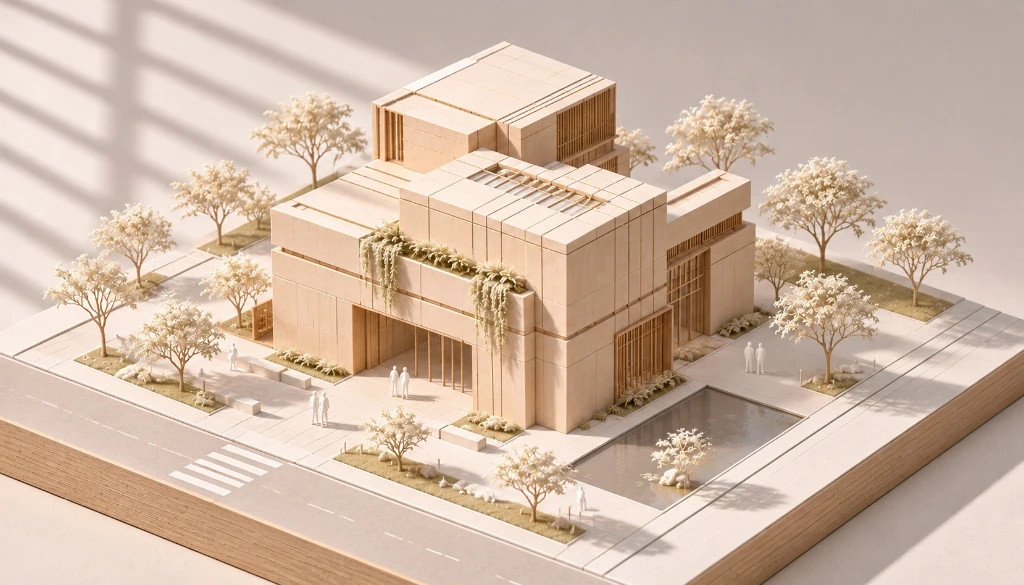
In the physical study model above—crafted from basswood blocks and museum board—these computational CSG partition lines become the tectonic joint pattern of the stone and concrete cladding, while the Boolean cutouts become a trellised roof skylight (C₄), a deeply shaded entrance portal (C₂), and a tranquil reflecting pool along the street edge.
Interior Daylight & Evening Presence
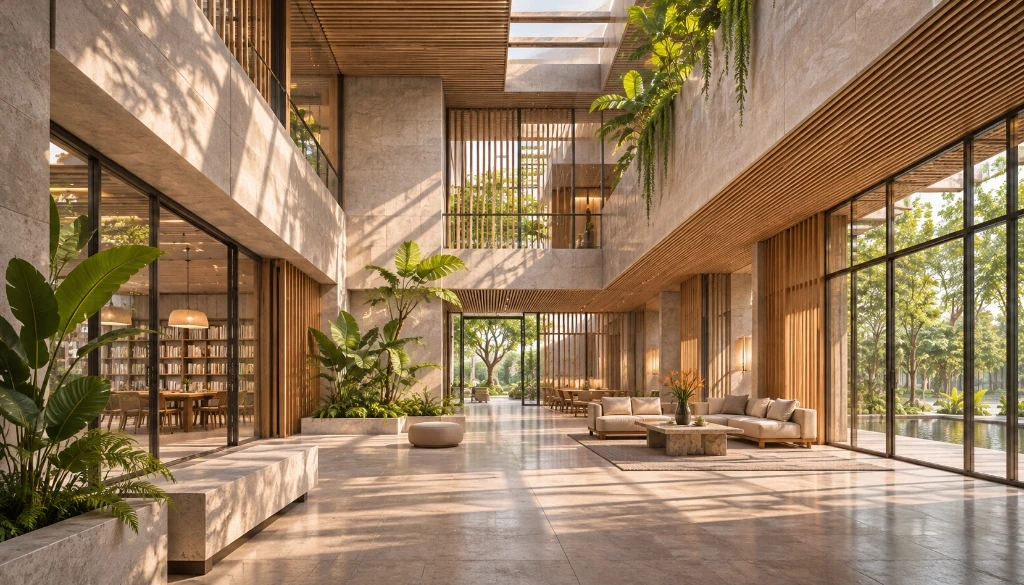
Stepping inside the building reveals the spatial purpose of the Boolean subtractions:
- The Vertical Light Slot & Central Courtyard: High overhead, the narrow light slot (
C₄) and central courtyard (C₁) slice through the heavy travertine-and-concrete mass, channeling controlled beams of tropical daylight down into the double-height public lounge and glass-enclosed reading library while keeping the lower spaces cool and shaded (37.1%of building surfaces receive under3 hoursof direct sun). - Tactile Warmth: Slatted timber ceilings, indoor tropical planting, and travertine benches soften the orthogonal geometry and connect the interior visually to the exterior reflecting basin.
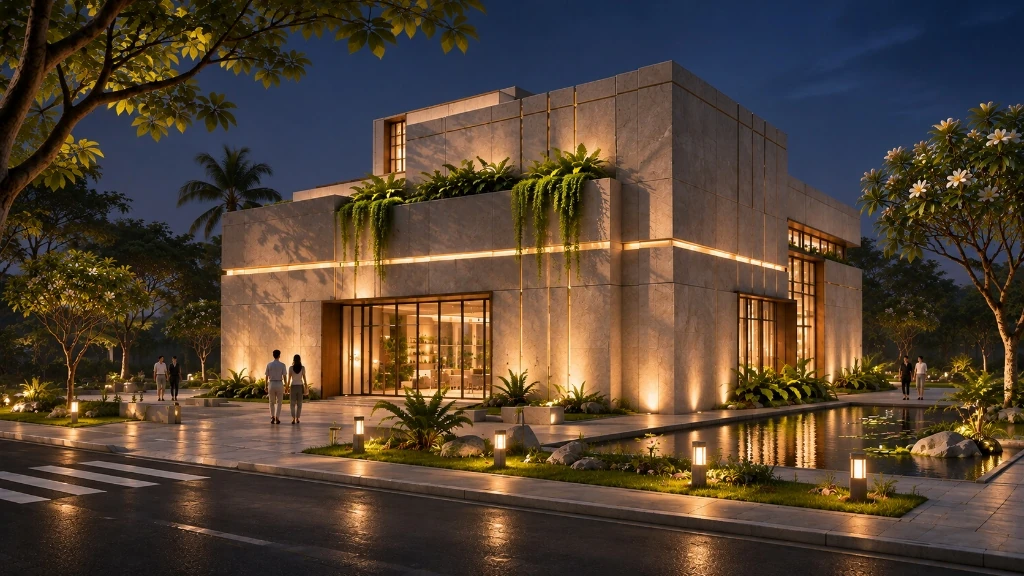
At night, the CSG partition lines that divided the computational mesh are reimagined as recessed linear lighting channels—tracing warm horizontal and vertical ribbons of light across the stone monolith while the carved entrance portal glows welcomingly along the avenue.