Concept & The Soft Explosion
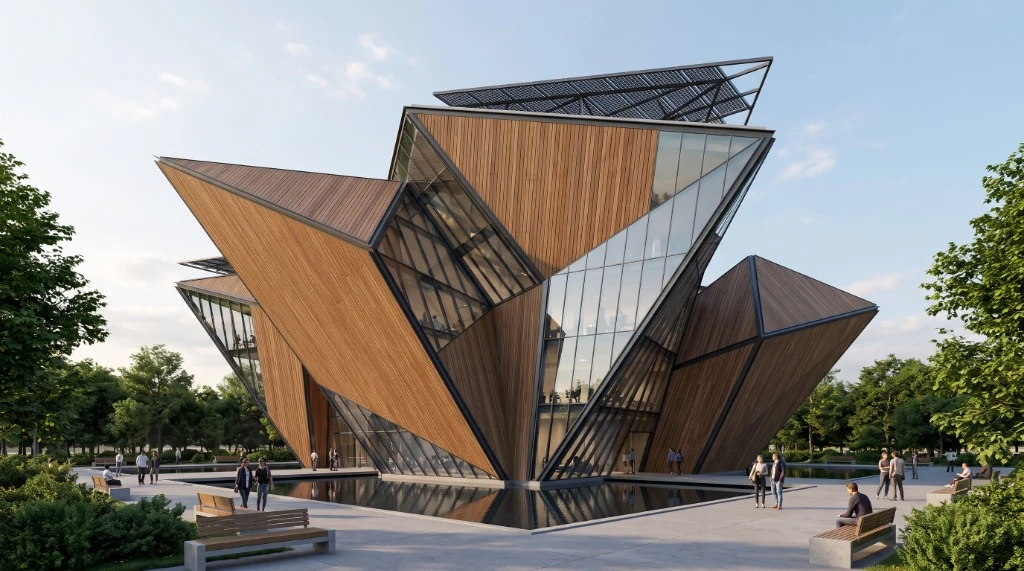
Shard Museum explores the tension between aggressive geometry and tactile warmth. While traditional museums are often static, monolithic boxes, this project envisions a cultural space that radiates outward like a cluster of crystals growing from a reflecting pool. To keep its sharp, overhanging shards from feeling hostile, the faceted envelope is wrapped in warm vertical timber slats—creating a “soft explosion” that balances mathematical precision with natural materiality.
The Computational Logic: Tilted & Twisted Prisms
The geometry is generated by a custom script in Julia. Rather than modeling a single static block, the algorithm builds the museum through a five-step transformation of a triangular prism, then collides four distinct shard volumes into one cohesive composition:
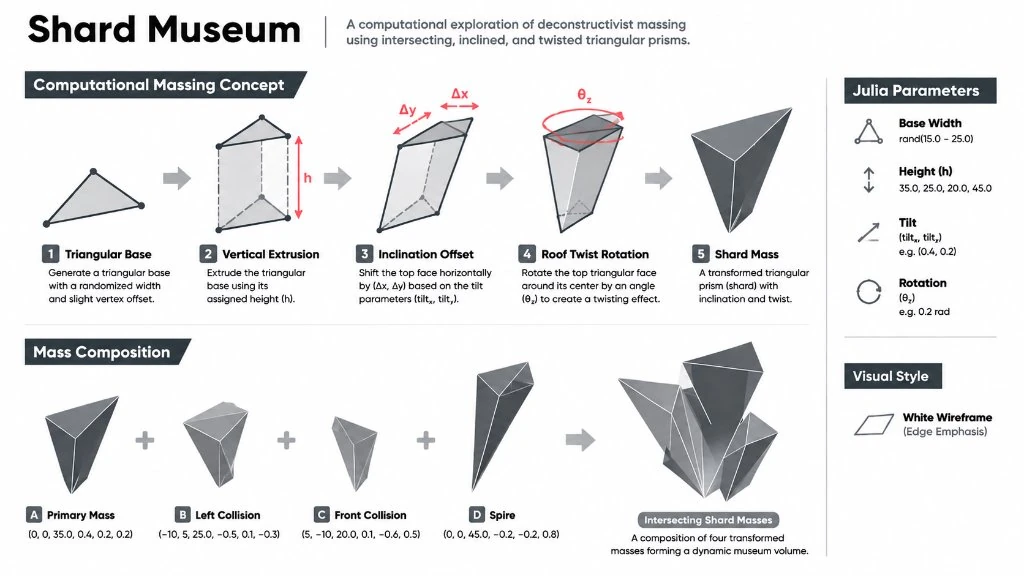
- From Triangular Base to Twisted Shard (Steps 1–5): Each volume starts with a randomized three-point triangular footprint on the ground plane (
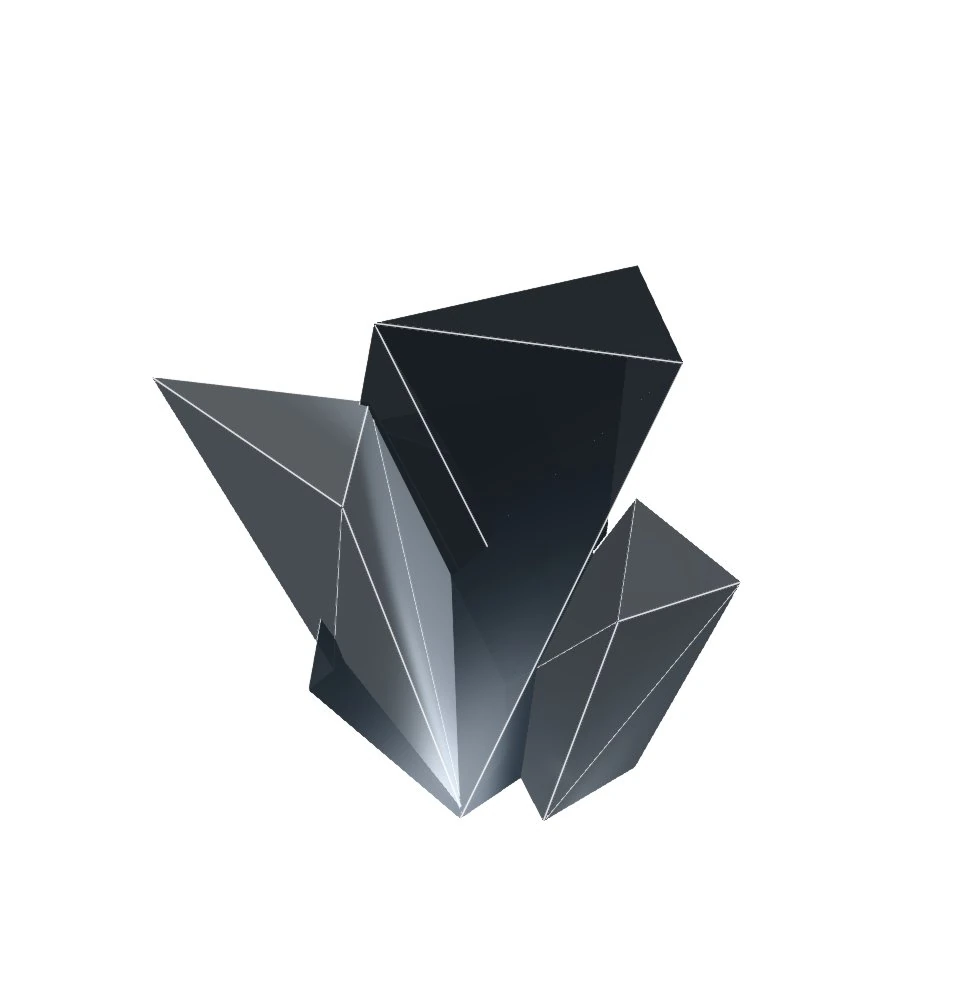
15to25meters wide) and is extruded vertically to its target height (h). The top triangle is then pushed sideways (Δx, Δy) to create a dramatic lean and rotated around its center (θz) to introduce a twist—while splitting each side wall diagonally into two flat triangles so every surface stays completely planar. - Four-Mass Collision (A + B + C + D): To create the final museum volume, the script intersects four configured shards around a central origin: a
35-meterPrimary Mass (A), a25-meterLeft Collision (B) leaning outward, a20-meterFront Collision (C) jutting toward the plaza, and a45-meterVertical Spire (D) anchoring the skyline.
View Julia Source Code (shard_museum.jl)
using GLMakie
using GeometryBasics
using Random
using Colors

# Initialize the 3D visualization environment
fig = Figure(
    size=(960, 1000),
    backgroundcolor=:white
)

# Configure the 3D architectural visualization
ax = Axis3(
    fig[1, 1],
    aspect=:data,
    azimuth=0.6π,
    elevation=0.15π
)

# Hide axis decorations and spines
hidedecorations!(ax)
hidespines!(ax)

# Generate an inclined and twisted triangular prism
function create_sharp_prism(
    center_x,
    center_y,
    height,
    tilt_x,
    tilt_y,
    rotation_z
)

    # Define the randomized width of the triangular base
    base_width = rand(15.0:25.0)

    # Generate three vertices forming the triangular base
    base_points = [
        Point3f(
            center_x + rand(-5:5),
            center_y + rand(-5:5),
            0
        ),

        Point3f(
            center_x + base_width,
            center_y + rand(-5:5),
            0
        ),

        Point3f(
            center_x + rand(0:5),
            center_y + base_width,
            0
        )
    ]

    # Calculate horizontal displacement based on height and inclination
    offset_x = tilt_x * height
    offset_y = tilt_y * height

    # Generate the upper triangular surface
    roof_points = [
        point + Point3f(offset_x, offset_y, height)
        for point in base_points
    ]

    # Calculate rotation components around the vertical Z-axis
    cos_angle = cos(rotation_z)
    sin_angle = sin(rotation_z)

    # Calculate the geometric center of the upper surface
    roof_center = sum(roof_points) / 3

    # Initialize the collection of rotated upper vertices
    rotated_roof_points = Point3f[]

    # Rotate the upper vertices around their geometric center
    # The triangular base remains stationary
    for point in roof_points

        # Calculate local coordinates relative to the roof center
        dx = point[1] - roof_center[1]
        dy = point[2] - roof_center[2]

        # Apply the rotation transformation
        rotated_x =
            dx * cos_angle -
            dy * sin_angle +
            roof_center[1]

        rotated_y =
            dx * sin_angle +
            dy * cos_angle +
            roof_center[2]

        # Store the transformed upper vertex
        push!(
            rotated_roof_points,
            Point3f(
                rotated_x,
                rotated_y,
                point[3]
            )
        )
    end

    # Combine the base and upper vertices
    # Vertices 1-3 define the triangular base
    # Vertices 4-6 define the transformed upper surface
    all_points = [
        base_points;
        rotated_roof_points
    ]

    # Construct the triangular faces of the prism
    faces = [

        # Bottom triangular surface
        GLTriangleFace(1, 2, 3),

        # Top triangular surface
        GLTriangleFace(4, 6, 5),

        # First lateral surface
        GLTriangleFace(1, 2, 5),
        GLTriangleFace(1, 5, 4),

        # Second lateral surface
        GLTriangleFace(2, 3, 6),
        GLTriangleFace(2, 6, 5),

        # Third lateral surface
        GLTriangleFace(3, 1, 4),
        GLTriangleFace(3, 4, 6)
    ]

    # Construct and return the final architectural mesh
    return GeometryBasics.Mesh(
        all_points,
        faces
    )
end

# Initialize the architectural massing composition
println("Generating Deconstructivist Museum...")

# Define a titanium-inspired metallic color palette
titanium_palette = [

    # Zinc Grey
    RGBAf(0.6, 0.65, 0.7, 0.9),

    # Dark Metal
    RGBAf(0.5, 0.55, 0.6, 0.9),

    # Light Aluminium
    RGBAf(0.7, 0.75, 0.8, 0.8),

    # Contrast Dark
    RGBAf(0.2, 0.25, 0.3, 0.95)
]

# Define four intersecting architectural masses
# Each configuration contains:
# center_x, center_y, height, tilt_x, tilt_y, rotation_z

mass_configurations = [

    # Primary architectural mass
    (0, 0, 35.0, 0.4, 0.2, 0.2),

    # Secondary mass intersecting from the left
    (-10, 5, 25.0, -0.5, 0.1, -0.3),

    # Secondary mass intersecting from the front
    (5, -10, 20.0, 0.1, -0.6, 0.5),

    # Tall inclined architectural spire
    (0, 0, 45.0, -0.2, -0.2, 0.8)
]

# Generate the architectural composition
for (index, configuration) in enumerate(mass_configurations)

    # Extract geometric transformation parameters
    center_x, center_y, height, tilt_x, tilt_y, rotation_z = configuration

    # Generate the inclined and twisted triangular prism
    architectural_mass = create_sharp_prism(
        center_x,
        center_y,
        height,
        tilt_x,
        tilt_y,
        rotation_z
    )

    # Select the corresponding metallic material color
    material_color = titanium_palette[
        mod1(index, length(titanium_palette))
    ]

    # Render the solid architectural geometry
    # FastShading provides basic surface illumination
    # Specular controls the intensity of reflected highlights
    # Shininess controls the appearance of metallic reflections
    mesh!(
        ax,
        architectural_mass,
        color=material_color,
        shading=FastShading,
        specular=Vec3f(0.8),
        shininess=10.0f0
    )

    # Highlight the geometric edges using a white wireframe
    # The wireframe emphasizes angularity and geometric fragmentation
    wireframe!(
        ax,
        architectural_mass,
        color=(:white, 0.6),
        linewidth=1.5
    )
end

# Optional human-scale reference
# Uncomment the following code to display a human-scale marker

# mesh!(
#     ax,
#     Rect3f(
#         Point3f(15, 15, 0),
#         Vec3f(0.5, 0.5, 1.8)
#     ),
#     color=:red
# )

# Display the final architectural composition
display(fig)
Interior Atrium & Evening Reflection
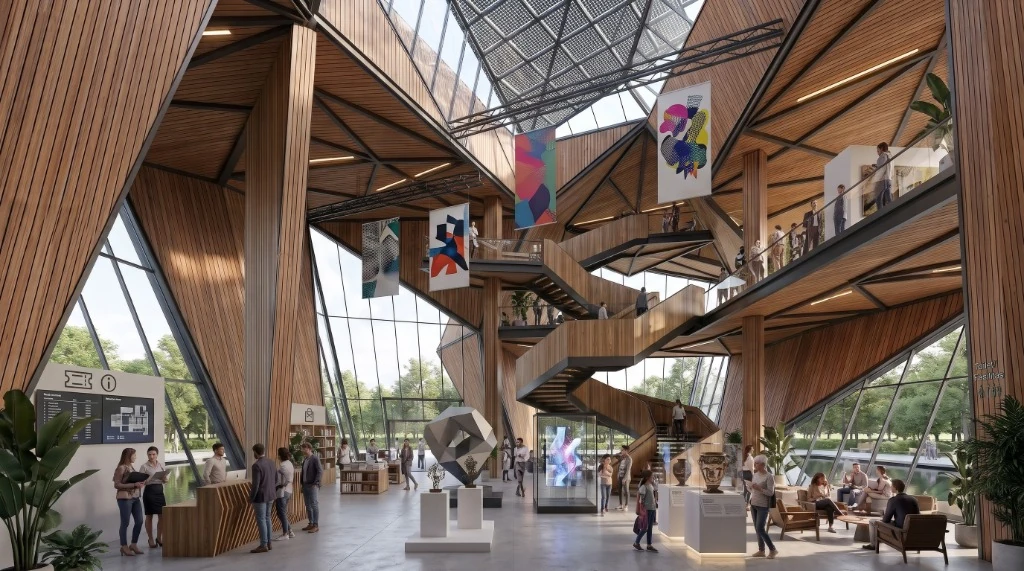
Inside, the collision of the four tilted prisms opens into a soaring, multi-level exhibition hall where the diagonal folds of the Julia mesh define both structure and daylighting:
- Timber-Clad Facets & Glazed Fissures: The diagonal crease lines that split each prism wall in the script become the boundary between solid timber-slat walls and full-height triangular glazing—allowing natural light and views of the park pool to slice deep into the ground-floor galleries.
- Angular Stair Spine & Louvered Skylight: At the center of the atrium, a sculptural timber-and-steel staircase winds upward to cantilevered mezzanine walkways, crowned by a triangulated skylight and solar-shading truss that filters overhead daylight.
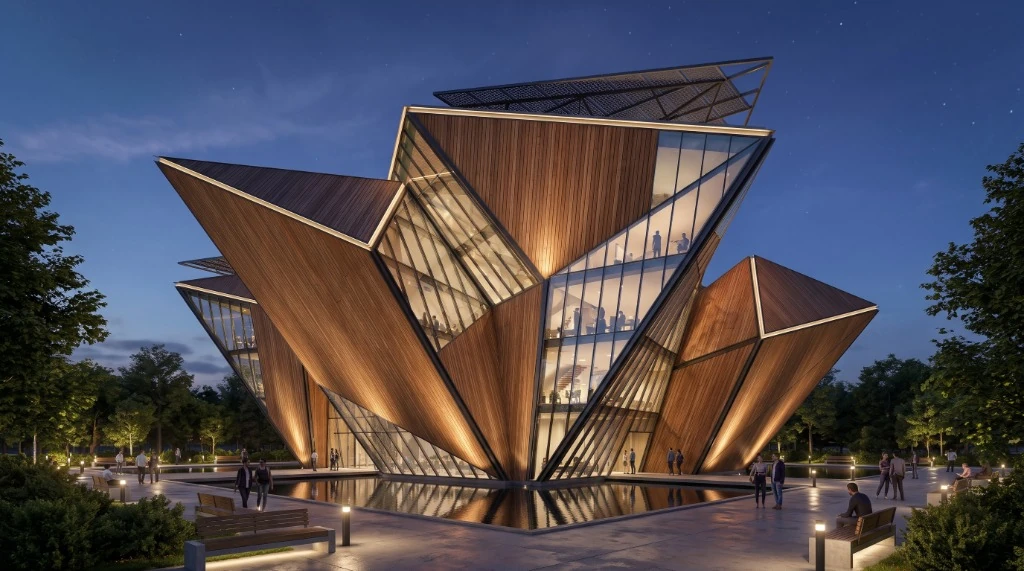
At twilight, exterior uplights graze the overhanging timber facets while warm gallery illumination glows outward through the diagonal glass splits—mirroring the four interlocking shards across the still water basin.