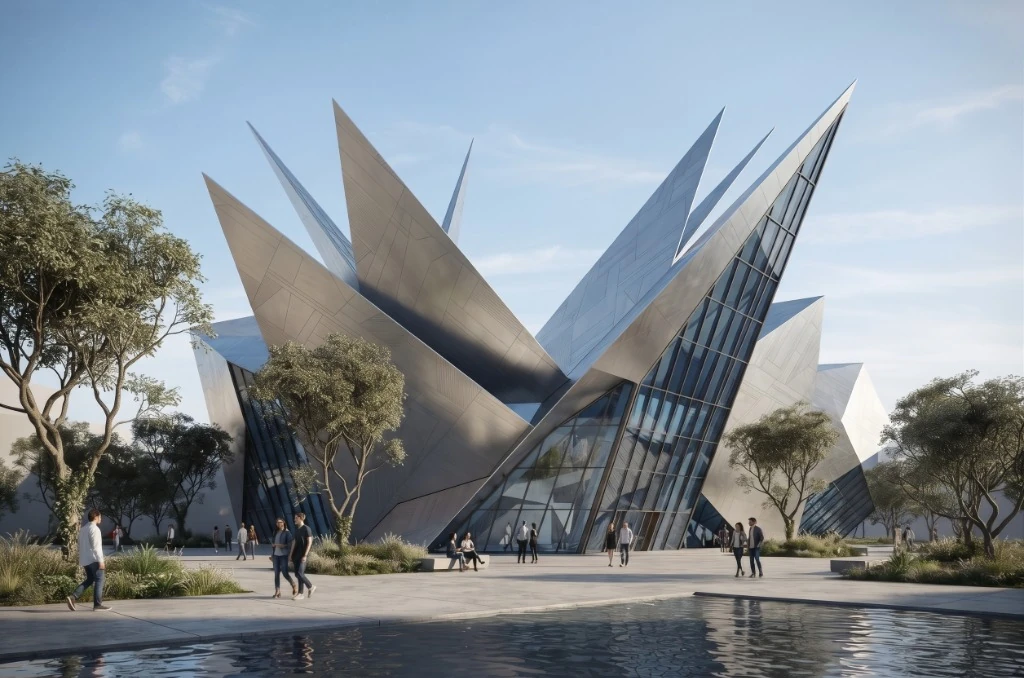
Concept & Spatial Collision
Titanium Clash explores the boundary between algorithmic randomness and architectural order. Drawing inspiration from deconstructivist form-making, the project tests how a simple script can generate high-energy spatial collisions—where sharp, soaring spires pierce and counter-balance one another above a calm reflecting pool.
The Computational Logic: Stochastic Shard Aggregation
Instead of starting with a manual sketch or a clay model, this study begins with a script in Julia that builds a complex deconstructivist massing by aggregating eight irregular tetrahedral shards around a shared origin:
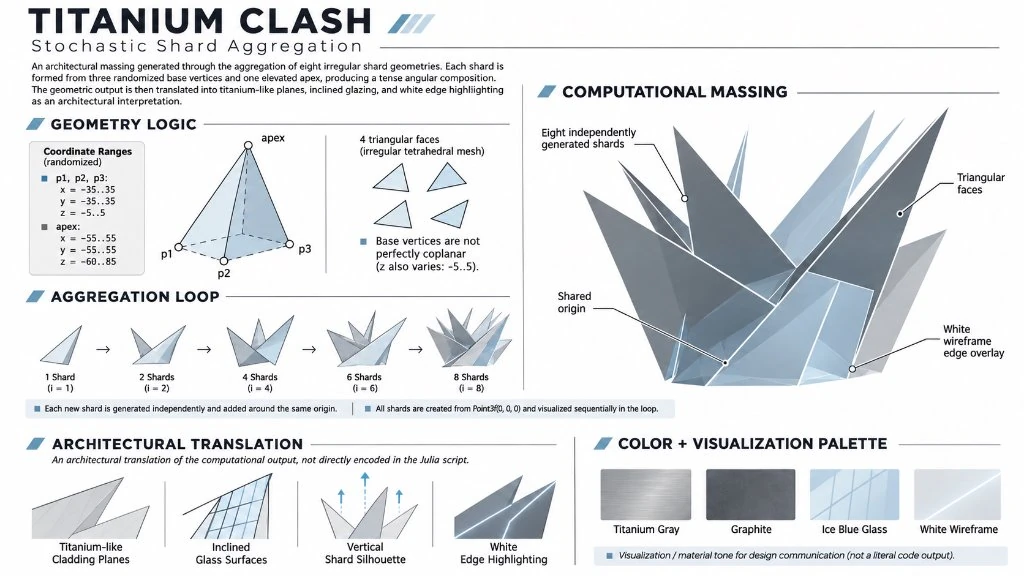
- Tetrahedral Geometry Logic (
p1, p2, p3+apex): Each shard is constructed from four randomized points—three base vertices scattered near ground level (x, y ∈ [-35, 35],z ∈ [-5, 5]) and one elevated apex projected high into the air (x, y ∈ [-55, 55],z ∈ [60, 85]). Connecting these four points forms an irregular four-face tetrahedron whose surfaces are always flat triangles. - Sequential Aggregation Loop (
1to8Shards): In an iterative loop (i = 1to8), eight independent shards are generated aroundPoint3f(0, 0, 0). As the loop progresses from a single pyramid to the full eight-shard cluster, the leaning volumes pierce and interlock with one another—rendered in a four-tone metallic slate palette with crisp white wireframe edges.
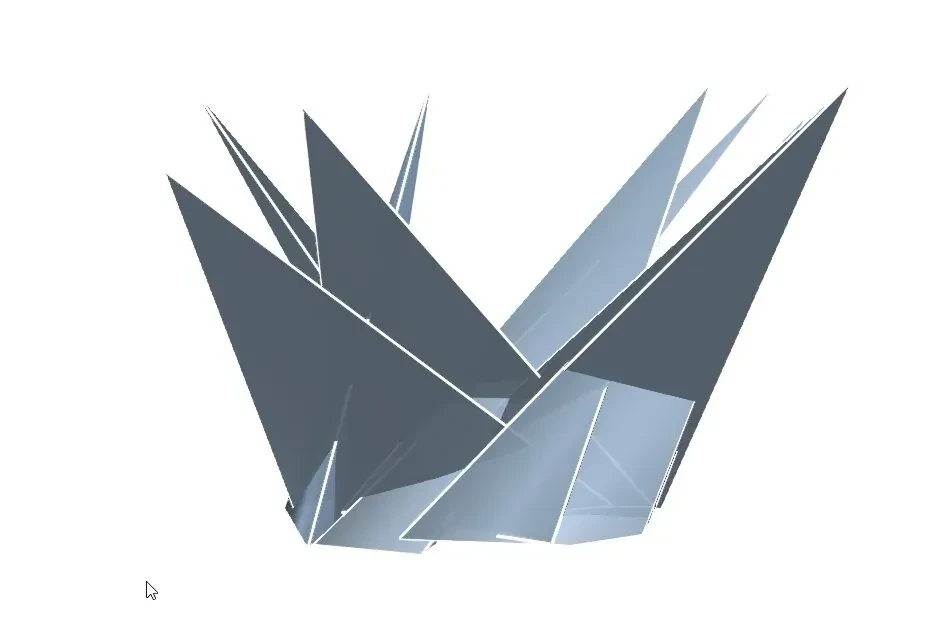
View Julia Source Code (titanium_clash.jl)
using GLMakie
using GeometryBasics
using Random
using Colors

# Initialize the 3D visualization environment
fig = Figure(size=(800, 800))

# Configure the 3D camera and viewing angle
ax = Axis3(fig[1, 1],
    aspect=:data,
    perspectiveness=0.2,
    azimuth=0.35π,
    elevation=0.15π
)

# Hide axis decorations and spines
hidedecorations!(ax)
hidespines!(ax)

# Define the spatial boundaries
limits!(ax, -60, 60, -60, 60, 0, 90)

# Display the visualization window
display(fig)

# Generate an aggressive shard geometry
function create_aggressive_shard(center)

    # Generate three randomly displaced base vertices
    p1 = center + Point3f(rand(-35:35), rand(-35:35), rand(-5:5))
    p2 = center + Point3f(rand(-35:35), rand(-35:35), rand(-5:5))
    p3 = center + Point3f(rand(-35:35), rand(-35:35), rand(-5:5))

    # Generate a randomly displaced elevated apex
    apex = center + Point3f(rand(-55:55), rand(-55:55), rand(60:85))

    # Assemble the four vertices of the shard
    vertices = [p1, p2, p3, apex]

    # Define the triangular faces of the geometry
    faces = [
        TriangleFace(1, 2, 4),
        TriangleFace(2, 3, 4),
        TriangleFace(3, 1, 4),
        TriangleFace(1, 2, 3)
    ]

    # Construct and return the triangular mesh
    return GeometryBasics.Mesh(vertices, faces)
end

# Define the architectural shard color palette
shard_palette = [
    RGBAf(0.5, 0.6, 0.7, 0.95),
    RGBAf(0.3, 0.4, 0.5, 0.95),
    RGBAf(0.7, 0.8, 0.9, 0.9),
    RGBAf(0.2, 0.2, 0.3, 1.0)
]

# Generate and visualize eight randomly shaped shards
@async begin
    for i in 1:8

        # Generate a new shard at the origin
        shard = create_aggressive_shard(Point3f(0, 0, 0))

        # Render the shard with a randomly selected color
        mesh!(ax, shard,
            color=rand(shard_palette),
            shading=true
        )

        # Highlight the triangular edges with white wireframes
        wireframe!(ax, shard,
            color=:white,
            linewidth=2.0
        )

        # Introduce a short delay for sequential generation
        sleep(0.3)
    end
end
The Role of the Architect: Curation & Physical Model
While the computer generates raw geometric collisions in seconds, the role of the architect shifts from manual drafter to spatial curator. Running the script dozens of times produces countless variations—some too fragmented, others too flat. The final composition was selected because its leaning spires achieve a dynamic visual equilibrium.
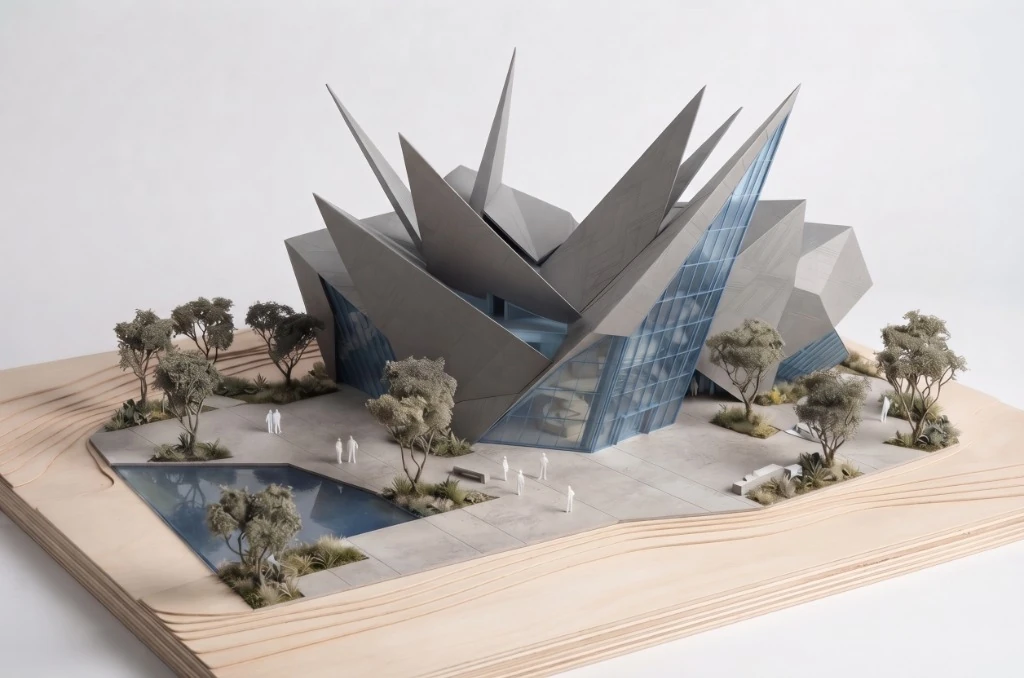
Because every shard is a pure four-point tetrahedron, every single surface in the composition is a flat triangle. As demonstrated in the physical study model above—built from matte metallic grey board, blue-tinted acrylic glazing panels, and a contoured plywood site base—these colliding digital shards can be unrolled and fabricated entirely from flat sheet materials without any curved panels.
Interior Atrium & Architectural Translation
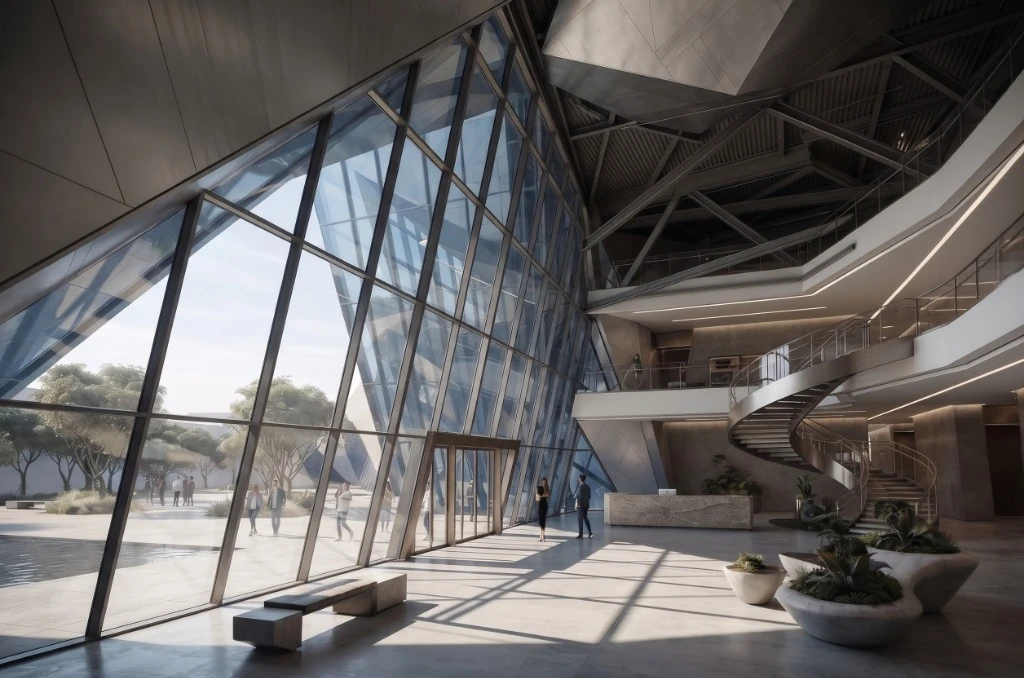
Because the Julia script only outputs raw tetrahedral meshes and color tones, translating the computational cluster into architecture involves four deliberate design interpretations:
- Titanium-Clad Planes & Inclined Glazing: The opaque gray and graphite faces of the digital mesh are interpreted as brushed titanium cladding panels, while the ice-blue facets become soaring, inclined glass curtain walls that flood the public lobby with daylight.
- Exposed Trusses & Helical Staircase: Overhead, long-span steel roof trusses and suspended polyhedral volumes reveal how the cantilevered spires lock together structurally, while a sweeping stainless-steel spiral staircase rises through the atrium as a fluid counterpoint to the sharp exterior angles.
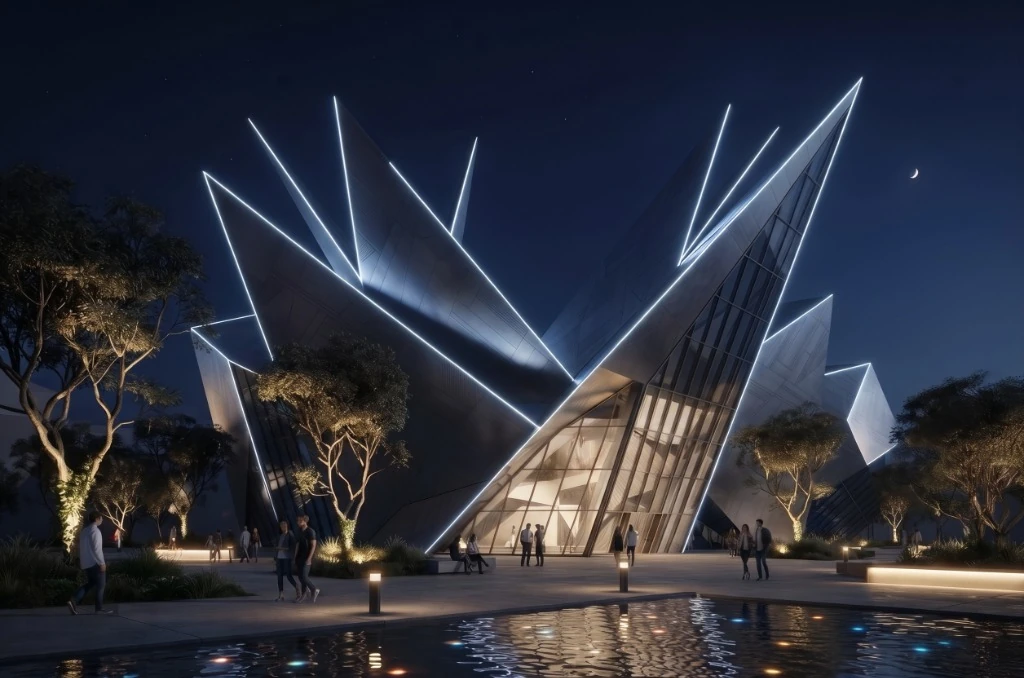
- White Edge Highlighting: At night, the white wireframe overlay plotted in the Julia script (
linewidth = 2.0) is reimagined as recessed linear LED lighting along the sharp ridge lines of the titanium shards—turning the computational wireframe into a glowing nocturnal silhouette reflected across the water basin.